AI video copyright for US brands: what human work to document
A finished video still needs a traceable rights story. Document the people, inputs, decisions, licenses and approval behind the delivered cut.
DATIK editorial team · Reviewed by Ilya Kostin · Sources checked 3 November 2026
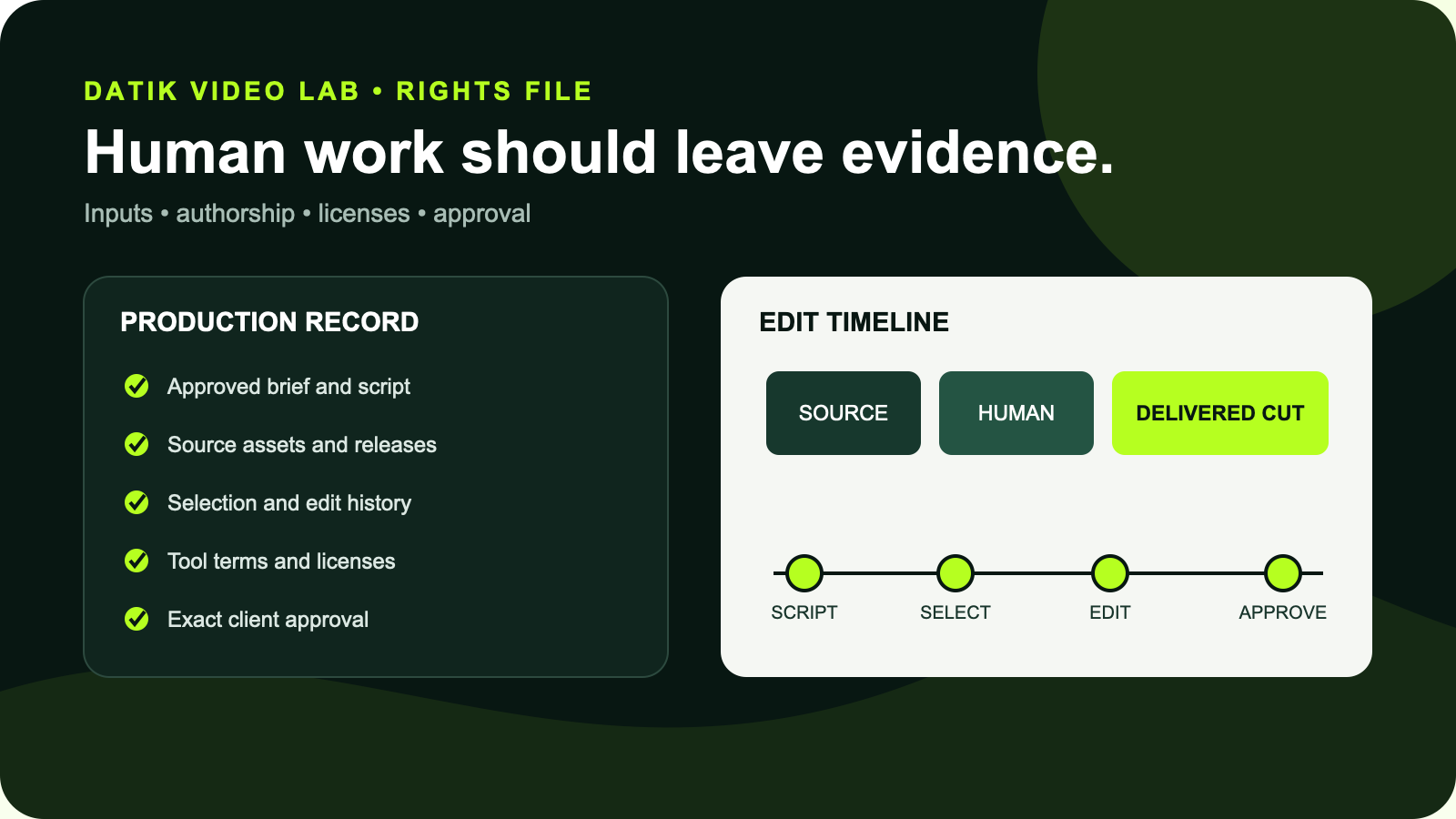
An AI video can look finished and still arrive with an unfinished rights story. A prompt history does not prove that a brand owns the final cut, that every input was cleared, or that every generated frame is protected by US copyright.
The useful question is not, “Was AI used?” It is, “What did people author, select, arrange, modify, approve, and license?”
For a brand team, the answer should live in the production file before launch. That file connects the creative decisions to the assets, contracts, tool terms, and final deliverables.
The short answer
Current US Copyright Office guidance treats human authorship as the dividing line. AI can assist a human creator without removing protection from human-authored expression. Purely AI-generated material, or material for which a person did not exercise enough creative control, is not protected by copyright. The analysis is case specific.
The Copyright Office also says that prompts alone generally do not provide enough control under today’s widely available systems. Protection may still exist in human-authored inputs, creative selection and arrangement, or substantial human modifications to generated material.
That makes documentation operationally important. A brand should be able to identify the human-authored parts of the finished work and separate them from generated material and licensed inputs.
Start with four different questions
Teams often compress four issues into one word: ownership. Keep them separate.
- Input rights: Did the production have permission to use the script, photographs, footage, music, voices, likenesses, logos, product files, and reference material?
- Human authorship: Which expressive choices came from people rather than the model?
- Contract rights: What does the client receive from the agency, creator, employee, model provider, stock library, and music supplier?
- Usage limits: Where, for how long, and in which media may the finished work and its components be used?
A clean answer to one question does not settle the others. A stock license does not transfer ownership of the footage. A signed agency agreement does not cure an unauthorized likeness. A human-edited sequence can include generated frames whose copyright status is limited.
What the Copyright Office says to document
The Copyright Office’s January 2025 report on copyrightability gives production teams a practical framework. It recognizes three common forms of protectable human contribution around AI output:
- human-authored material that remains perceptible in the output
- creative selection, coordination, or arrangement of material
- creative modifications or additions made by a person
None is a magic phrase. The evidence has to match the actual work.
If a director wrote a script, designed a shot sequence, selected takes, changed timing, built transitions, and made detailed edits, retain those records. If a designer supplied an original illustration that remains visible in the generated scene, preserve the source file and its provenance. If the team generated hundreds of clips and assembled a deliberate narrative from a small set, keep the selects and edit history.
The goal is not to manufacture paperwork after the fact. It is to preserve the creative record that already exists during a disciplined production.
A prompt log is useful, but it is not the authorship file
Prompt logs can explain what tool was used, when an asset was created, and how a team iterated. They help with reproducibility, vendor review, and internal governance.
They should not be presented as conclusive proof of copyright. The Copyright Office’s current position is that prompts alone usually function as instructions rather than sufficient control over the expressive result.
Treat the prompt log as one part of a broader evidence package:
- dated creative brief and script versions
- storyboard or shot list
- human-authored reference assets and source files
- generation records and tool/version notes
- selects with reasons for acceptance or rejection
- edit timeline, project file, and change history
- sound design, captions, graphics, and color decisions
- client comments and final approval
This is the controlled approach described in our AI video production workflow. The record should follow the work, not be reconstructed from memory at delivery.
Keep an input-rights ledger
Before generation begins, list every material input and the basis for using it. A simple ledger can prevent the most expensive late-stage questions.
- Brand logo: client-supplied asset, governed by brand guidelines, with upload and approval retained.
- Product photos: assignment or license from the photographer, with the agreement and source files retained.
- Performer voice: a written release defining media, term, and territory, stored with the recording.
- Music: a license covering the intended platforms and paid media, stored with the receipt and track ID.
- Stock footage: the project license and invoice, including any ban on standalone redistribution.
- Generated clips: the named tool, account plan, provider terms, and generation log.
Avoid entries such as “found online” or “client sent it.” Identify who supplied the asset and what permission supports the planned use.
Changing another person’s work does not automatically create ownership. The Copyright Office’s fair-use guidance warns that you cannot claim copyright in someone else’s work merely because you changed it without the owner’s consent. Fair use is fact specific and is not a sourcing policy.
Record human decisions at the moments that matter
Brief and script
Keep the approved objective, audience, offer, factual claims, tone, and script. Mark who wrote and revised each version. If the script began with model assistance, record the human rewriting and verification that produced the approved copy.
Visual plan
Preserve the storyboard, shot list, framing instructions, continuity plan, and Visual DNA. These show that the team designed a coherent piece rather than accepting an undirected output.
Generation and selection
Record the tool, account, material settings, and source assets used for each approved clip. Keep the selection sheet. A note such as “chosen for product-label legibility and correct left-to-right action” is more useful than a folder called final_final_3.
Editing and finishing
Save the edit project and a change log. Human choices in timing, sequence, cropping, compositing, graphics, captions, sound, and color may be central to the finished expression. Our AI video editing checklist provides a practical finishing gate.
Approval
Retain the exact review file the client approved, the date, the approver, and any usage conditions. Approval should match the delivered master, not an earlier watermarked cut.
Contracts still control the commercial relationship
Copyrightability and contractual rights are related but different. A contract can define who may use a deliverable and under what conditions even when parts of the output have uncertain copyright protection.
The agreement should address:
- deliverables and source files included
- ownership or license of human-authored work
- treatment of generated material whose protection may be limited
- preexisting agency tools, templates, and know-how
- third-party assets and pass-through license terms
- approved AI tools and prohibited inputs
- consent for voice, face, and likeness uses
- media, territory, duration, exclusivity, and paid-ad rights
- reuse for versions, cutdowns, localization, and training
- warranties and responsibility for client-supplied assets
- retention period for the production archive
Do not rely on “work made for hire” as a universal shortcut. Under 17 U.S.C. § 101, commissioned work qualifies only in specified categories and when the parties sign a written agreement stating that it is a work made for hire. If it does not qualify, a transfer of copyright ownership generally must be in a signed writing under 17 U.S.C. § 204.
Have qualified counsel adapt the contract. A production checklist can surface the issue, but it cannot give a legal conclusion for every project.
What the client should receive
A traceable delivery is more than an MP4 link. Package the approved assets with a compact rights and provenance record:
- approved master and platform versions
- final script and claim substantiation
- asset ledger with licenses and releases
- AI tools used and the role each played
- description of material human authorship and editing
- known restrictions and expiration dates
- approval record
- archive owner and retention date
- contact for rights questions
The client does not need every failed generation in its inbox. The producer should retain the working archive for the agreed period and be able to explain the final asset.
Registration requires honest disclosure
The Copyright Office’s March 2023 registration guidance says applicants must disclose AI-generated content in works submitted for registration and explain the human-authored contribution. Previously registered works that omitted material AI-generated content may need correction.
Registration strategy belongs with copyright counsel, especially for a valuable campaign or reusable character system. The production team’s job is to provide a truthful record: what people created, what the system generated, what was excluded, and what the final arrangement contains.
Do not describe the entire video as human-authored if that is not true. Do not describe it as entirely machine-made when the team wrote, designed, selected, edited, and finished substantial expression. Precision is more defensible than a sweeping label.
Buyer-side review before launch
- Can the producer identify every material input and its rights basis?
- Are performer, voice, and likeness permissions written and scoped?
- Do tool terms cover commercial use under the plan actually used?
- Is the human-authored contribution described with supporting files?
- Are music, fonts, footage, and stock assets licensed for paid media if needed?
- Does the contract address generated material without promising impossible exclusivity?
- Does the delivery identify restrictions and renewal dates?
- Is a named person responsible for the archive?
If a producer cannot answer these questions, the problem is not that the video used AI. The problem is that the production is not traceable.
What remains unsettled
This area is still developing. Courts, registration decisions, provider terms, and state laws can change the risk analysis.
As of 3 November 2026, the Copyright Office continues to describe copyrightability as a case-by-case inquiry grounded in human authorship. This article does not predict how a court or the Office would evaluate a particular video.
Use this workflow as a production-control system, not a legal opinion. For a major campaign, disputed source, recognizable person, franchise character, or registration decision, involve qualified US counsel.
Official sources
- US Copyright Office, Copyright and Artificial Intelligence, Part 2: Copyrightability
- US Copyright Office, Copyright and Artificial Intelligence study
- US Copyright Office, registration guidance for works containing AI-generated material
- 17 U.S.C. Chapter 1, including the work-made-for-hire definition
- 17 U.S.C. Chapter 2, ownership and transfers
- US Copyright Office fair-use FAQ
Build the production file before the campaign needs one
DATIK Video Lab scopes the evidence package with the creative work: input rights, human decisions, approvals, and delivery records. Book a Video Lab pilot to turn a campaign brief into a traceable production plan.
Frequently asked questions
Is an AI-generated video automatically public domain?
No blanket assumption is safe. Purely AI-generated material may lack copyright protection, while human-authored elements, creative arrangement, and human modifications may qualify. Rights in licensed components and contractual use restrictions can still apply.
Are prompts enough to claim copyright in the output?
The US Copyright Office currently says prompts alone generally do not provide sufficient human control over expressive elements produced by widely available systems. Preserve the broader record, including scripts, source assets, selection, arrangement, and editing.
Does paying an AI video agency mean the client owns everything?
Not automatically. Ownership and usage depend on the contract, human-authored work, provider terms, and third-party licenses. State what is assigned, licensed, excluded, or restricted.
What about cloned voices and digital likenesses?
Treat consent as a separate written rights track. Define the person, uses, media, territory, term, transformations, and storage. DATIK publishes a separate commercial voice-cloning consent guide.
Build the rights file before launch
Bring the brief, source assets, releases, AI tools, edit plan, usage scope, and approval owner. We will map the evidence and delivery package before production expands.
4300 Biscayne Blvd, Miami, FL 33137 · info@datik.click