How to test five video hooks without producing five full ads
Build one approved ad body, treat the opening as a replaceable module, and keep the test stable enough to explain the result.
DATIK editorial team · Reviewed by Ilya Kostin · Sources checked 9 November 2026
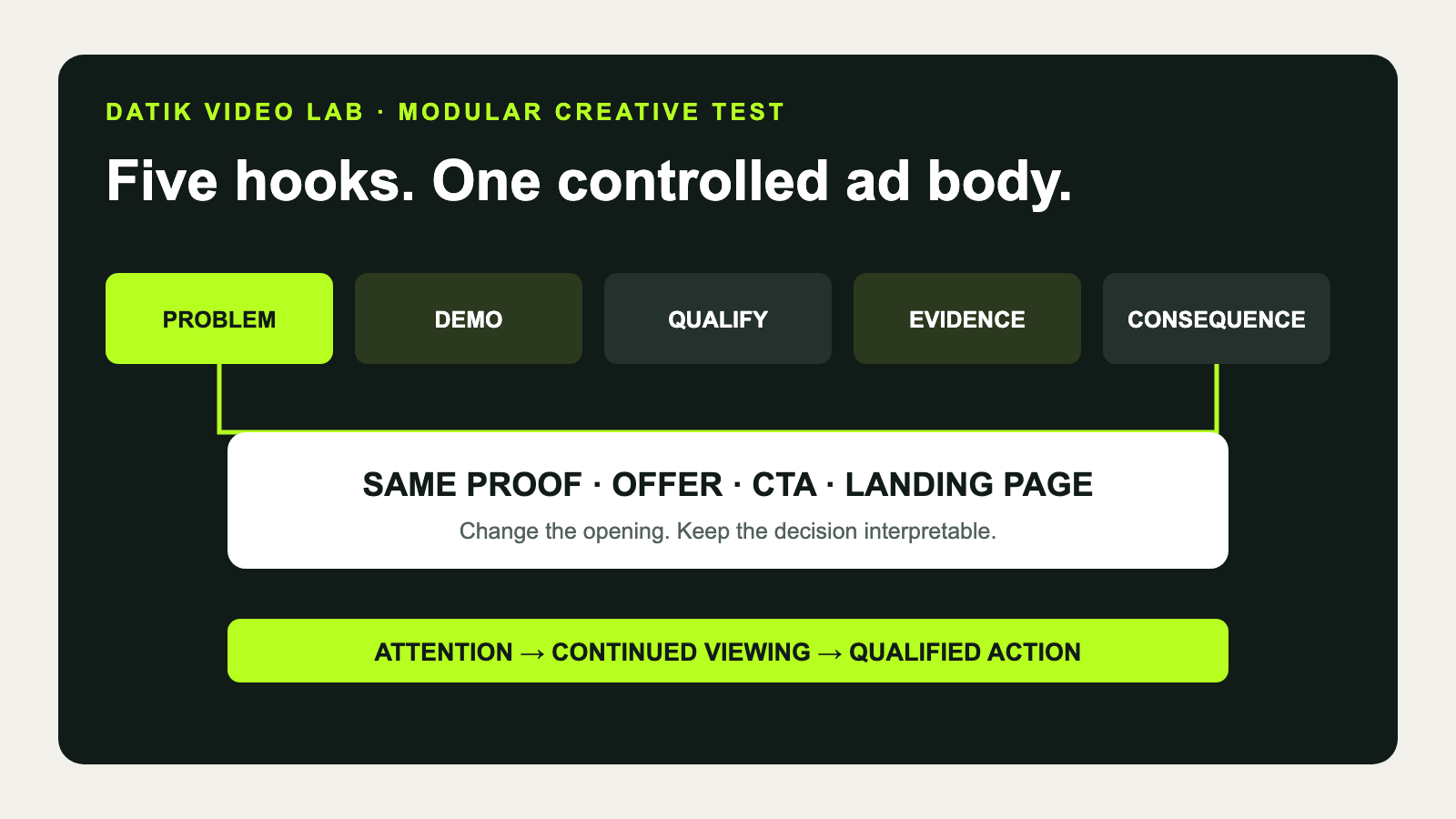
Five opening ideas do not require five unrelated productions. Build one approved ad body, treat the opening as a replaceable module, and keep the rest of the test stable enough to explain the result.
The saving comes from production design, not from making five shallow rewrites. Each hook should present a different reason to keep watching. The offer, proof, call to action, audience, landing page, and measurement window stay controlled.
Define the decision before writing the hooks
Write one sentence that explains what the test will decide. For example: which opening argument earns more qualified product-page visits from the same paid audience? That is tighter than asking which video performs best.
Name the primary metric and the business guardrail before launch. A short-view rate can measure early attention. It cannot establish lead quality or revenue. If the campaign exists to generate enquiries, track the path from the view through the landing page to a qualified action.
Google Ads custom experiments allow advertisers to split traffic and budget between original and trial campaigns and select primary success metrics. Google also warns that auction conditions, budgets, bids, and assets can change exposure. TikTok's Split Testing documentation similarly separates audiences and supports creative assets, including the opening two or three seconds, as a test variable. Use the experiment tool available for the actual campaign. Do not recreate a controlled test by manually posting five files and hoping distribution stays equal.
Lock the common ad body
Create one body that can accept every opening. It should carry the same product evidence, offer, claim language, call to action, end card, and destination. Keep the approximate runtime and aspect ratio stable.
The transition matters. A hook that flows naturally into the body has an advantage over one that requires a hard reset. Give each opening the same transition allowance, such as one line or one short bridging shot. If one variant receives a custom middle section, the test no longer isolates the hook.
Approve the body before making all five modules. Otherwise late changes multiply across every export.
Give each hook a different job
Five cosmetic versions of the same sentence produce weak learning. Use distinct arguments that fit the offer:
- problem hook: names the situation the buyer already recognizes
- demonstration hook: shows the product or mechanism doing useful work
- qualification hook: tells the right viewer who the ad is for
- evidence hook: opens with a supportable number, observation, or comparison
- consequence hook: shows what continues to happen if the problem is left alone
Do not force all five families into every campaign. A regulated service may not have a claim that belongs in an evidence hook. A visual product may be strongest when the first frame simply demonstrates it. Remove any hook that depends on an unsupported claim or misleading image.
Build an opening module specification
Treat the first scene as a small deliverable with its own fields:
- variant ID and hypothesis
- first frame and on-screen text
- spoken line or opening sound
- duration and transition point
- source assets and rights status
- protected product or brand details
- rejection reasons
- final file name and campaign identifier
The opening may use live footage, motion graphics, approved stock, AI generation, or a hybrid. The method does not change the approval burden. Check product accuracy, likeness, voice, claims, captions, safe zones, music, and the impression created by the complete opening.
Our shot decision guide helps choose the method. Use the generation log when a generated opening requires several attempts.
Reuse the expensive parts
The body usually contains the work that should not be repeated: exact product shots, demonstration evidence, presenter performance, sound mix, approved claims, captions, end card, and delivery settings. Build those elements once.
Prepare the timeline so the opening can be swapped without moving the rest of the edit. Reserve a fixed duration and transition marker. Keep audio stems separate. Store captions by variant, because the first line may change while later captions remain identical.
One master body does not mean one universal file. Each platform export still needs the correct codec, aspect ratio, safe area, caption treatment, and metadata. The modular system reduces creative duplication. It does not remove delivery QA.
Control what the audience sees
A useful test changes one main variable. Google recommends keeping experiment arms comparable, and its Demand Gen guidance says experiments should differ by one variable where possible. TikTok describes split testing as a way to hold other variables constant while separate audience groups see different versions.
Keep these conditions aligned when the platform permits it:
- audience and exclusions
- placement and optimization event
- bid strategy and budget treatment
- start and end dates
- offer, landing page, and tracking
- thumbnail or cover image
- frequency rules
If the thumbnail changes with the hook, record that as part of the creative treatment. Do not later claim that the opening line alone caused the difference.
Use a result ladder, not one attention metric
Read the result in order:
1. Delivery: did each variant receive enough comparable exposure? 2. Opening attention: did viewers remain after the hook? 3. Continued viewing: did the same people stay through the proof and offer? 4. Destination quality: did clicks reach and engage with the intended page? 5. Business action: did the campaign produce the qualified action named in the brief?
A hook can win the first step and lose the fifth. Sensational wording may attract cheap views from people who do not want the offer. Keep the early metric, but do not promote a winner that damages downstream quality.
Set the stop rule before launch
Do not choose a universal impression threshold from a blog post. Required volume depends on the platform, expected event rate, audience size, budget, and difference the business needs to detect. Use the platform's experiment guidance and the analyst or media buyer responsible for the campaign.
Write three outcomes into the brief:
- winner: the planned decision rule is met without a guardrail failure
- inconclusive: the evidence cannot separate the variants reliably
- invalid: delivery, tracking, audience, offer, or another controlled condition changed
Inconclusive is a real result. It may mean the hooks are too similar, the event is too rare, or the test needs more volume. It does not authorize selecting the prettiest chart.
Keep a test record another team can audit
Save the hypothesis, variant files, campaign IDs, dates, audience settings, budget split, metric definitions, landing-page version, tracking check, platform report, and decision. Record changes made while the test was live.
Separate observation from interpretation. “Variant C had the highest qualified-visit rate during the stated window” describes the report. “Customers prefer demonstrations” is a broader conclusion and may require repetition across campaigns or audiences.
The record should also say what happens next. Promote the winner, repeat the test, revise the body, or stop. A testing program that never changes production is reporting, not learning.
Run a five-hook production pilot
Start with one approved body and two sharply different hooks. Confirm that tracking, exports, and the platform experiment work. Then add the remaining variants if the campaign has enough traffic and budget to support them.
Bring DATIK Video Lab one campaign brief. We will define the controlled body, hook modules, approval evidence, delivery files, and decision rule before producing the full set.
Sources and review limits
- Google Ads Help: About custom experiments
- Google Ads Help: Create A/B experiments for Demand Gen campaigns
- TikTok Ads Manager: About Split Testing
- TikTok Ads Manager: Split Testing Variables
Sources were checked on November 9, 2026. Platform interfaces, eligibility rules, metrics, and experiment methods can change. Verify the current documentation inside the ad account before launch. DATIK does not guarantee a winning hook, cheaper media, leads, or revenue.
Frequently asked questions
Should the thumbnail change with each hook?
Keep it stable if the hook is the only intended variable. If the cover is part of the opening treatment, vary it deliberately and describe the test as a creative-package comparison.
Can we test five hooks organically?
You can compare directional results, but posting time, initial audience, distribution, and platform recommendation may differ. Record those limits and avoid presenting the result as a controlled experiment.
Can AI generate all five openings?
It can help produce suitable illustrative variants. Exact products, people, claims, rights, continuity, and transitions still need review. Choose the method from the shot requirement rather than using one tool for every hook.
What if no hook wins?
Record the test as inconclusive or invalid according to the prewritten rule. Check whether the variants were meaningfully different, delivery was comparable, tracking worked, and the selected event occurred often enough.
Which metric should decide the winner?
Use the metric closest to the campaign's business objective that the test can measure reliably. Early-view metrics diagnose attention. Qualified actions are stronger when the campaign has enough volume and sound tracking.
Test the opening without rebuilding the ad
Bring the campaign objective, audience, offer, approved body, landing page, tracking plan, and review owner. We will define the hook modules and decision rule before production expands.
4300 Biscayne Blvd, Miami, FL 33137 · info@datik.click