AI video vs traditional video production: choose by shot risk
Choose capture, generation, graphics, stock, or a hybrid from the evidence each shot must preserve.
DATIK editorial team · Reviewed by Ilya Kostin · Sources checked 8 November 2026
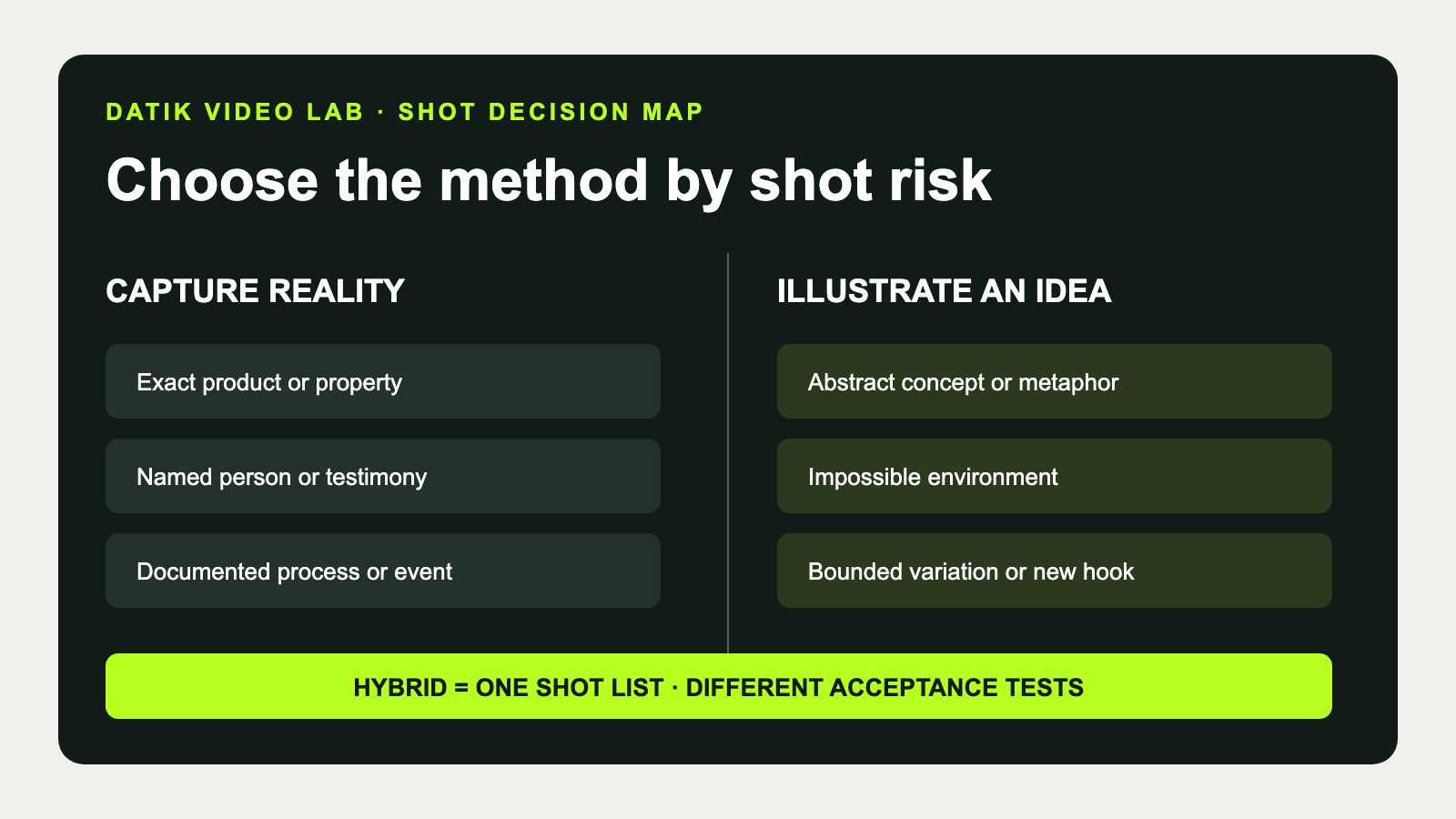
The production method should follow the evidence a shot must preserve. A generated environment can be useful when the frame is illustrative. A real camera is usually the safer choice when a buyer must inspect an exact product, property, process, or performance.
The useful comparison is not AI versus a film crew for an entire project. Classify each shot, set its acceptance test, then choose generation, live action, motion graphics, stock, or a hybrid. One 30-second ad may use all five.
Start with the claim the viewer will take from the frame
A shot makes a claim even when nobody speaks. A close view of a machine suggests that the pictured mechanism exists. A person describing a result may look like a customer. A room shown in a hotel ad may be understood as the room a guest can book.
Write the likely viewer takeaway beside every shot. If that takeaway must be literally true, capture the underlying reality or use an approved source image that preserves it. Generative video can visualize an idea, but it should not quietly replace evidence.
The Federal Trade Commission evaluates advertising in context, including words, pictures, and implied claims. Its small-business guidance says advertising must be truthful and non-deceptive, and advertisers need evidence for objective claims before an ad runs. The production plan should therefore identify who approves product, performance, price, safety, and testimonial claims.
Use five shot classes instead of one production label
Documentary shots
Documentary shots show what exists or what happened: a property, installation, event, interview, factory step, completed job, or customer experience. Record the real subject. Keep the date, location, release, and source footage with the project.
AI can still help with transcription, cleanup, rough assemblies, captions, or background treatment when those changes do not alter the evidence. The approved cut should not turn a reconstruction into documentary footage without a clear reason and disclosure.
Exact product shots
Use live action, product photography, 3D assets supplied by the manufacturer, or controlled animation when geometry, label text, color, controls, fit, or mechanical behavior must match the item sold. Generative output may support an exploratory board or background, but every frame containing the product needs an exactness review.
This category includes packaging. A logo that drifts, a cap that changes shape, or a label with invented text can create a false product representation even when the overall clip looks polished. Our reference-image checklist defines the views and protected details to collect before motion work starts.
Human performance shots
Film a real employee, founder, actor, or customer when delivery and identity matter. Record consent, approved use, media, territory, term, and any limits on editing or synthetic alteration. Do not infer permission to clone a voice or face from permission to record one performance.
A generated presenter can work for an obviously fictional explainer or an approved digital double. It creates a different review problem. The team must check identity, speech, gesture, disclosure, and the exact words attributed to the person. The voice-cloning consent checklist covers the additional controls.
Illustrative shots
Illustrative shots explain an idea rather than prove a fact. Abstract data movement, a visual metaphor for delay, an impossible transition, or a conceptual future environment can fit generation well. Variability may help here because several visual directions can be tested before the sequence is locked.
The brief still needs boundaries. Name the subject, action, camera behavior, duration, protected brand features, and rejection reasons. Log the selected attempt. The AI video generation log is designed for that record.
Derivative versions
Short cut-downs, aspect-ratio adaptations, language versions, and alternate hooks begin from an approved master. Editing and motion graphics are often more predictable than regenerating the underlying scene. Use generation only when the adaptation needs new visual material and the same acceptance test can be applied.
Compare control at the point where failure becomes expensive
Live action concentrates risk before and during the shoot. The team must secure the subject, crew, location, equipment, releases, schedule, and safety plan. A missed shot may require another setup or another day. Those costs are visible, which helps a buyer inspect the plan.
Generative production moves more uncertainty into iteration. The first clip may appear quickly, while continuity, anatomy, readable text, product detail, and repeatability take longer to resolve. A low generation price does not tell you the cost of an approved sequence.
Ask where the project becomes expensive to change. For live action, it may be after the set is struck. For generated work, it may be after several shots are approved around one unstable character or product. Place the strongest approval gate immediately before that point.
Build the budget from work, not from the label
Compare the complete approved deliverable. The budget may include creative direction, script, storyboard, reference preparation, talent, crew, equipment, location, travel, generation attempts, 3D work, editing, sound, captions, rights review, versions, project management, and archive.
AI generation can remove some capture costs. It adds tool usage and review time. Traditional production can cost more to mobilize, but one controlled shoot may supply a reusable library of exact product and human footage. The cheaper method depends on the shot and the number of approved uses, not the word AI in the proposal.
Request the same scope from each vendor:
- final runtimes and aspect ratios
- number and type of shots
- source assets and rights work
- included review rounds
- captions, sound, thumbnails, and platform versions
- source files, project files, and archive period
- change-order rule
Our AI video cost guide explains why model credits are only one line in a production quote.
Treat schedule claims as estimates with different failure modes
A generated test may be ready on the day a live-action production would still be booking a location. That does not establish the delivery date for the finished campaign. Generated work may stall on a difficult recurring subject, provider outage, policy restriction, or repeated review failure.
Live action has its own dependencies: availability, weather, permits, shipping, travel, and reshoots. A credible schedule shows the dependencies and approval windows for the method being proposed. It also names the fallback. If a generated product shot does not hold its shape after the agreed attempts, the fallback may be a photographed plate, 3D render, motion graphic, or live capture.
Keep a human-authorship record for both methods
The U.S. Copyright Office states that using AI as an assistive tool does not prevent copyright protection. Protection depends on sufficient human authorship and is decided case by case. Material generated wholly by AI is not protected merely because someone supplied prompts.
Keep the script drafts, storyboard, shot selections, edit timeline, sound decisions, graphics, revisions, and final arrangement. For live action, retain releases and source footage. For AI-assisted work, also retain inputs, provider records, selected outputs, rejected attempts, and the human changes made after generation. This is an operating record, not a promise that every element will qualify for copyright protection.
A practical shot decision map
- Exact product shape or label: start with live capture, approved photography, or supplied 3D. Obtain product-owner frame approval.
- Real property or completed work: use live capture and retain the date, location, and source footage.
- Named person giving testimony: use live capture with a release and approved transcript.
- Approved synthetic presenter: use a controlled avatar workflow with consent, script, and a disclosure decision.
- Abstract concept or impossible environment: consider AI generation or motion graphics, then obtain creative and brand approval.
- Interface or measurable process: use screen capture or designed motion graphics with product-owner review.
- New hook from an approved campaign: begin with editing, graphics, or bounded generation and record version approval.
The table sets a starting point. A food brand may need live product footage and a generated environment. A manufacturer may use exact 3D geometry inside a conceptual sequence. A founder can be filmed once and placed beside motion graphics. Hybrid production is a shot plan, not a compromise made after either method fails.
Run a proof shot before choosing the campaign method
Pick the shot with the highest combination of business importance and production uncertainty. Use the actual product, presenter, claim, placement, and approval owner. A generic demo avoids the constraints that will decide the job.
Write the proof-shot test before production:
- what the viewer must understand
- which details must remain exact
- what may vary
- the maximum included attempts or setups
- the review owner and deadline
- the fallback if the shot fails
- the files and records delivered at the end
Approve the production mix only after the proof shot. DATIK Video Lab uses a bounded pilot for this reason. Bring us one real brief, and we will classify the shots before recommending capture, generation, graphics, or a hybrid.
Sources and review limits
- FTC Advertising FAQs for Small Business
- U.S. Copyright Office, Copyright and Artificial Intelligence
- NIST Artificial Intelligence Risk Management Framework: Generative Artificial Intelligence Profile
Sources were checked on November 8, 2026. Tool terms, platform rules, provider controls, and disclosure requirements can change. This guide is an operational decision framework, not legal advice. Verify current contracts and rules for the actual campaign.
Frequently asked questions
Is AI video always cheaper than traditional production?
No. Generation may reduce capture costs, but difficult continuity, exact products, and repeated review can consume the saving. Compare the complete approved deliverable and the reuse value of the source material.
Is traditional video always more accurate?
It is usually the stronger starting point for documenting a real subject, but filming can still mislead through staging, editing, framing, or unsupported claims. Accuracy depends on the source, the treatment, and the approval record.
When does a hybrid production make sense?
Use a hybrid when some shots must preserve reality and others are illustrative. The shot list should state which method creates each frame and which acceptance test applies.
Should an AI-generated commercial be disclosed?
The answer depends on the context, platform, contract, jurisdiction, and impression the content creates. Decide before production and obtain qualified legal review where the treatment could mislead or uses a person's likeness or voice.
What should a proof shot include?
Use the real campaign constraint: the actual product or presenter, intended placement, claim, review owner, and delivery requirement. Set the attempt limit, acceptance test, and fallback in writing.
Choose the method after the proof shot
Bring the placement, product or presenter, claim, source assets, approval owner, and delivery requirement. We will classify each shot and define its acceptance test before production expands.
4300 Biscayne Blvd, Miami, FL 33137 · info@datik.click