How to evaluate an AI video production company: a buyer scorecard
A polished reel is one input. Compare the evidence, decision owners, production controls, rights records, review path, and handoff behind it.
DATIK editorial team · Reviewed by Ilya Kostin · Sources checked 7 November 2026
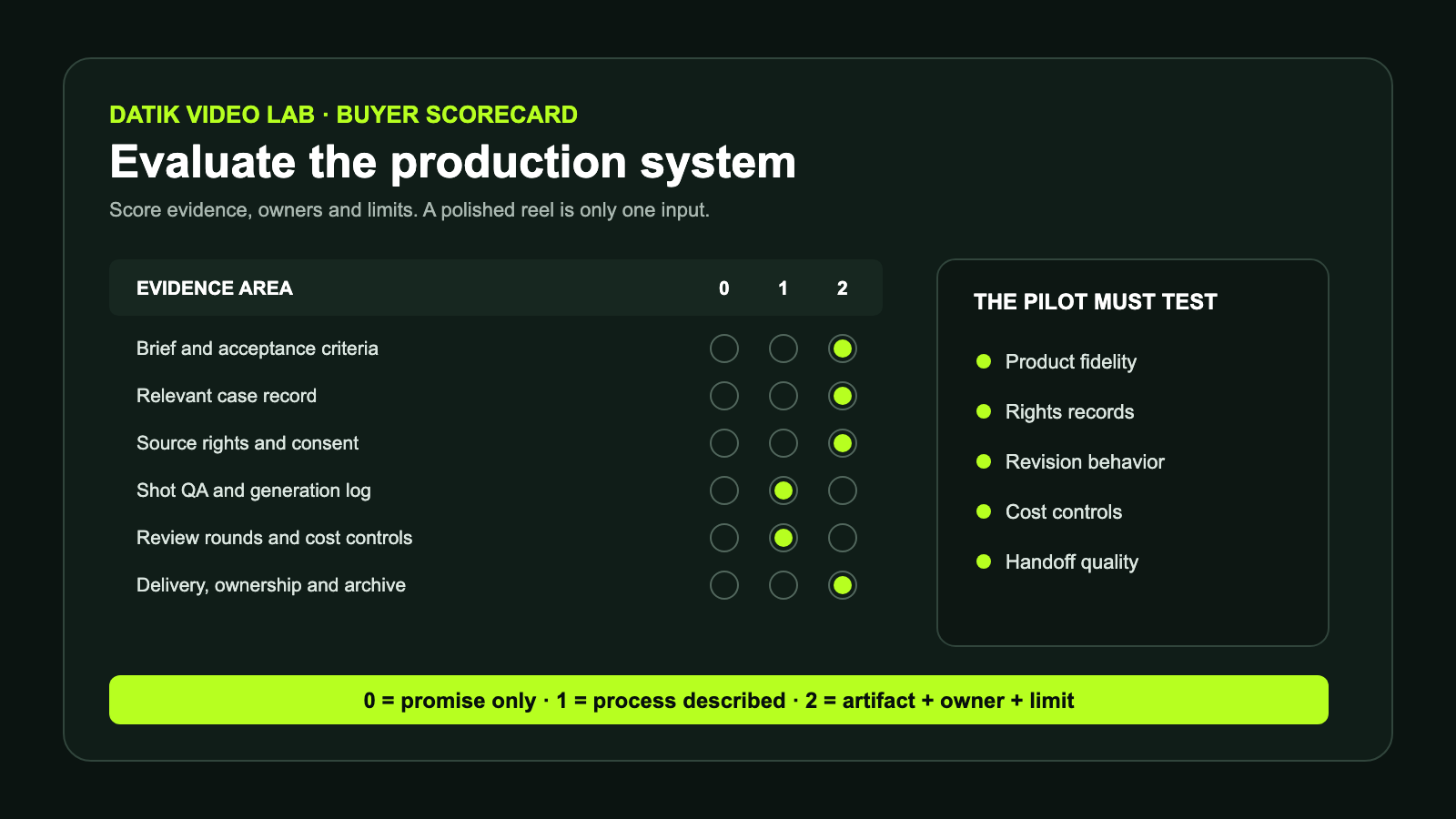
A polished reel proves that a studio can assemble polished moments. It does not show how the team protects a product shape, clears a voice, handles a failed generation, or responds when an approver changes the brief.
Evaluate the production record behind the reel. A useful vendor review covers ten areas: the brief, relevant evidence, source rights, creative control, tool policy, shot QA, review gates, cost controls, delivery, and measurement.
Score the evidence, not the sales answer
Use a simple scale for each section:
- 0 means the vendor gives no answer or only a promise.
- 1 means the vendor describes a process but provides no sample record.
- 2 means the vendor shows a relevant artifact, names the owner, and explains the limit.
The maximum is 20 points. The total helps compare proposals, but a high score cannot cancel a zero in a risk that matters to your campaign. A spokesperson project may require documented consent before price enters the discussion. A product launch may fail if the package changes shape between shots.
Set the non-negotiable areas before the calls. Then use the same questions and the same sample brief with every vendor.
1. Can the company turn the business goal into acceptance criteria?
Ask the vendor to restate one deliverable from your brief. The answer should name the audience, placement, required action, runtime, aspect ratios, claims, product details, review owner, and delivery date.
“Create a premium brand video” is not an acceptance criterion. “Deliver a 15-second vertical paid-social cut that shows the approved bottle and ends on the supplied offer card” can be reviewed.
Look for a written shot or storyboard approval before generation expands. Our 15-second storyboard guide shows the level of specificity a short project can support.
2. Does the portfolio example match your actual risk?
Request one complete case close to the proposed work. A montage of disconnected shots hides the inputs, failed attempts, edit decisions, and client constraints.
Ask the company to separate:
- what the client supplied
- what the AI tools generated
- what people wrote, directed, recorded, or edited
- what changed during review
- what the final campaign measured, if anything
A relevant example does not need to reveal another client's confidential material. The vendor can show a redacted brief, shot list, generation record, review note, or delivery manifest. If the only evidence is a public reel, score the section accordingly.
Treat results carefully. A view count does not prove that a production method caused the result. Ask for the platform, date range, media spend, attribution method, and comparison period before using performance as a buying signal.
3. Can the vendor trace every important input?
The proposal should assign a source and rights status to product images, logos, fonts, music, stock, voices, people, scripts, and reference clips.
Ask who checks provider terms and who keeps the evidence. A link to current terms, a license receipt, a release, or a client-supplied asset record is stronger than “commercial use is included.”
The U.S. Copyright Office says AI-assisted work may contain protectable human authorship, while material generated wholly by AI is not protected merely because someone supplied prompts. Copyrightability is case-specific. A vendor should document human writing, arrangement, editing, and other creative decisions without promising that the entire output will qualify for protection.
Use the AI video licensing checklist to inspect the chain before a pilot starts. This buyer guide is operational information, not legal advice. Campaigns with material rights risk need qualified counsel.
4. Who makes the creative decisions?
Ask who owns the script, shot design, reference selection, generation review, edit, sound, and final quality decision. “Our AI handles it” is not an accountable production structure.
The answer may involve employees and subcontractors. That is normal when the proposal names the responsible producer, access rules, deliverables, confidentiality terms, and approval path. A hidden chain is harder to manage than an openly coordinated one.
Request one example of a rejected shot and the reason it failed. Specific rejection language shows how the team thinks. “The product label changes at frame 42” is useful. “It did not feel right” is not.
5. Does the tool policy survive a model change?
Do not select a company only because it uses the newest model. Select a team that can explain which tool fits each shot and what happens when a provider changes terms, removes a feature, or produces unstable results.
Ask for:
- the tools expected for your project
- the reason each tool is in the workflow
- what client material enters each service
- whether the service may retain or use that material
- the fallback when a tool cannot meet the acceptance criteria
NIST's Generative AI Profile discusses third-party due diligence, service agreements, testing, evaluation, and documented controls across the AI lifecycle. It does not certify a studio. It does support asking a vendor how third-party AI services enter the production and risk process.
6. How does the company test shots before editing?
Generation should have a stop condition. Ask how the team checks subject identity, product geometry, readable text, physical motion, continuity, camera movement, safe areas, and the intended edit point.
A still frame can pass while the complete shot fails. Review the beginning, middle, and end at normal speed. Then review the clip inside the sequence.
The vendor should be able to show a rejection reason, selected attempt ID, source export, and approved reference. Our generation log template connects those records without pretending that a model can reproduce every output.
7. Are review rounds and change orders defined?
Count decisions, not the word “revisions.” The contract should identify which version the client reviews, who consolidates feedback, how long the review window stays open, and which changes require regeneration.
Separate three categories:
- production correction, when the delivery misses an approved requirement
- creative revision, when the client changes an open choice
- scope change, when an approved brief, asset, placement, runtime, or concept changes
Unlimited revisions usually mean that the boundary has not been written. A credible proposal can state the included rounds and give a change-order path for new work. The AI video revision guide provides a contract-ready structure.
8. Can the quote explain what drives cost?
Model credits are one line in the budget. The quote may also include direction, reference preparation, generation attempts, editing, sound, rights review, captions, versions, project management, and archive work.
Ask what is fixed, estimated, excluded, and passed through at cost. Ask how the team records generation usage and who approves an overage. If a monthly tool subscription serves several clients, the vendor should explain the allocation method rather than assigning the whole subscription to one job.
Do not reward a precise number built on vague deliverables. Compare the scope, review path, and final files first. Our AI video production cost guide lists the work that often sits outside the generation line.
9. What exactly arrives at handoff?
The contract should list the master, platform versions, captions, audio mix or stems, thumbnails, source files, project files, licenses, releases, disclosure record, approval evidence, and archive period that apply to your project.
Ask what the client owns and what remains licensed. Ask whether the vendor can transfer the project to another editor. A rendered file may be enough for a single short campaign. An ongoing program needs clearer continuity and exit terms.
C2PA Content Credentials can carry verifiable provenance about an asset's history in supported workflows. They are useful when the production and publishing stack supports them. They do not replace the internal rights file, client approval, or delivery manifest.
10. Does measurement match the campaign objective?
Require a measurement plan before launch. The metric may be completed views, qualified visits, product-page actions, leads, assisted conversions, or creative test results. The correct choice depends on the placement and buying decision.
Ask who owns the ad account, analytics, UTM structure, baseline, and reporting window. A production company should not guarantee virality, reach, revenue, or search visibility that depends on distribution and market response.
For advertising claims and endorsements, the FTC requires truthful, non-deceptive advertising and substantiation. Endorsements must reflect the endorser's honest experience or opinion, and material connections may require disclosure. Ask who approves the claim and disclosure in the final frame, caption, landing page, and paid placement.
Run one bounded pilot before a campaign
Choose a difficult shot that represents the full campaign. Use the real product, real approver, intended platform, and actual rights constraints. A generic demo tests the vendor's demo process.
Write the pilot acceptance test before production begins:
- one approved concept and storyboard
- one primary deliverable plus one meaningful adaptation
- named source assets and rights records
- a generation and rejection log
- defined review rounds and change-order rule
- a delivery manifest and archive period
- a short post-pilot review against the original criteria
The pilot should expose communication quality, fidelity, revision behavior, record keeping, and handoff. It does not need to predict campaign performance.
Red flags that deserve a pause
- The company guarantees virality or business results without controlling distribution.
- The portfolio cannot be tied to a brief, client inputs, human work, or a final delivery.
- The quote omits editing, sound, rights review, versions, or review rounds.
- The team will imitate a recognizable person or voice without a consent discussion.
- “Commercial rights included” replaces a review of source assets and provider terms.
- The vendor will not name subcontractors' roles or the person accountable for delivery.
- The handoff is a rendered file with no written ownership, license, or archive terms.
- The company cannot explain what would make it reject its own generated shot.
Use the scorecard during the call
Send the questions in advance. Ask each vendor for the same three artifacts: one relevant case record, one sample production log, and one delivery manifest. Score the evidence while the answer is fresh.
DATIK Video Lab can be evaluated by this same standard. Request a scoped pilot. We will name the acceptance criteria, open risks, approval owners, and handoff before production starts.
Sources and review limits
- NIST Artificial Intelligence Risk Management Framework: Generative Artificial Intelligence Profile
- U.S. Copyright Office, Copyright and Artificial Intelligence
- FTC Advertising FAQs for small businesses
- C2PA Content Credentials specifications
Sources were checked on November 7, 2026. NIST states that AI RMF 1.0 is being revised. Tool terms, provider controls, and platform disclosure rules can change. Verify the contract and current service terms for the actual campaign. This article is a purchasing framework, not legal advice or a certification of any vendor.
Frequently asked questions
What score should an AI video production company receive?
There is no universal passing score. Set non-negotiable sections from the campaign's risks, then compare vendors on the same 20-point scale. A zero on consent, source rights, or product fidelity can outweigh a strong total.
Should we choose the company with the newest AI video tools?
No. Tools change quickly. Choose a team that can explain shot-level decisions, protect client material, document rights, test outputs, and switch tools when the acceptance criteria require it.
Is a low-cost test useful?
Yes, when it includes the controls the full campaign needs. Use the actual brand assets, approver, placement, rights constraints, review rounds, and handoff. A disconnected demo tests only the demo.
Should the vendor disclose subcontractors?
The proposal should name their roles and the party accountable for their work. It should also cover access, confidentiality, rights, review, and delivery. The buyer does not need every freelancer's private details to understand the production chain.
Can a vendor guarantee that an AI-generated video is copyrightable?
No. The U.S. Copyright Office evaluates human authorship case by case. Ask the vendor to document human contributions and source rights, then obtain legal advice when copyright protection is material to the campaign.
Test the production system with one real brief
Bring the placement, product or presenter constraints, source assets, approvers, rights questions, and expected handoff. We will turn them into a bounded pilot with written acceptance criteria.
4300 Biscayne Blvd, Miami, FL 33137 · info@datik.click